
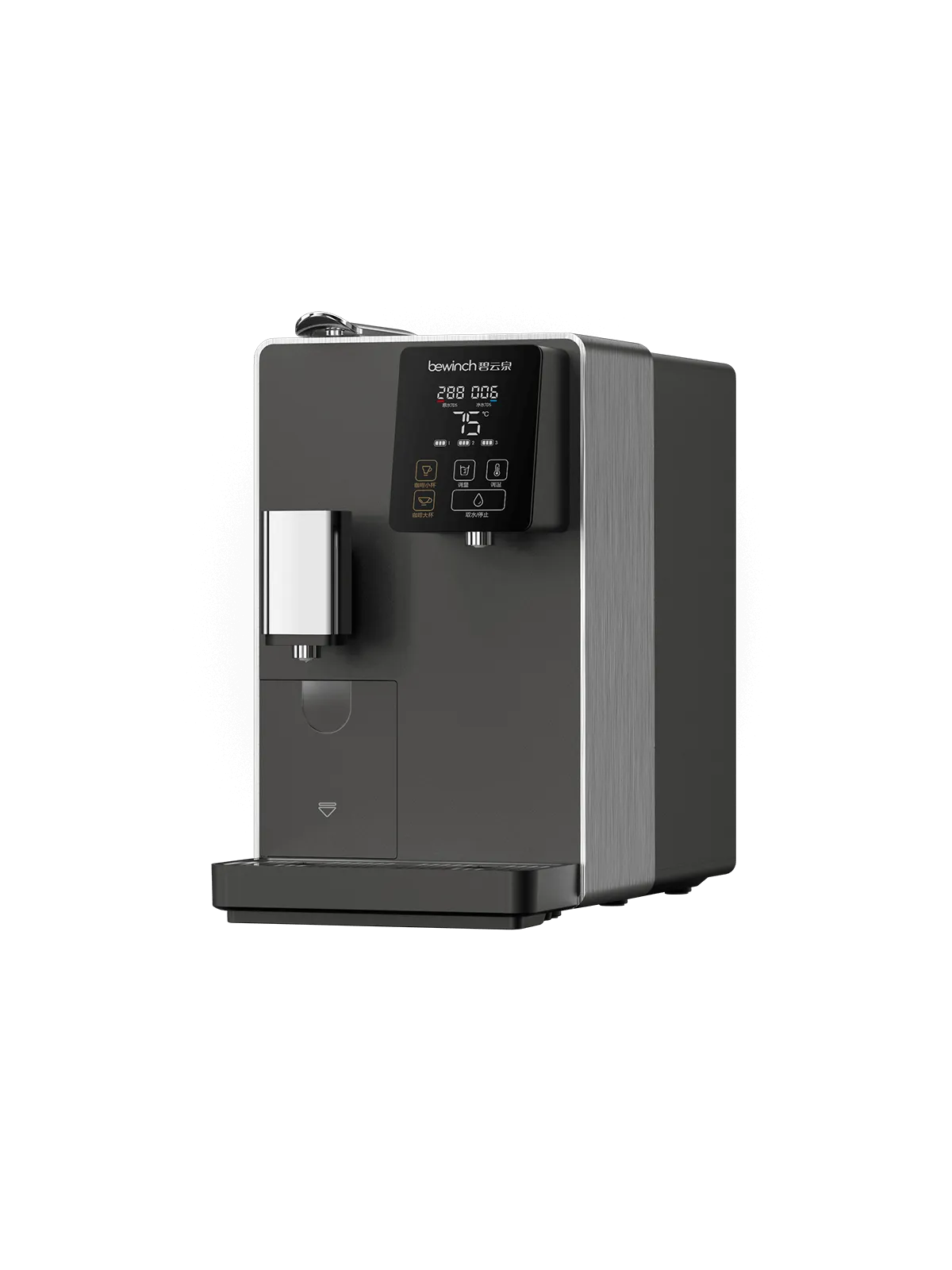
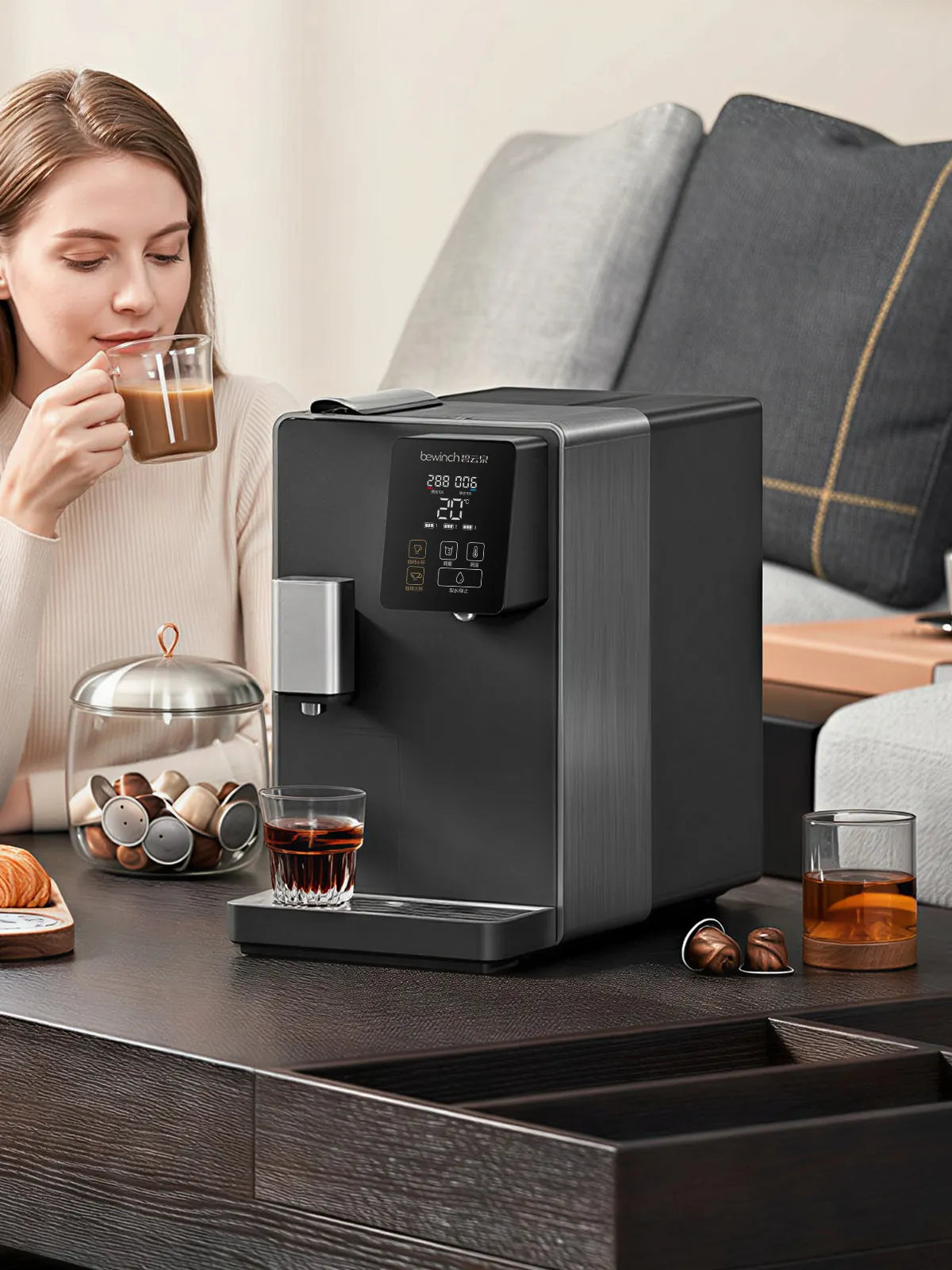

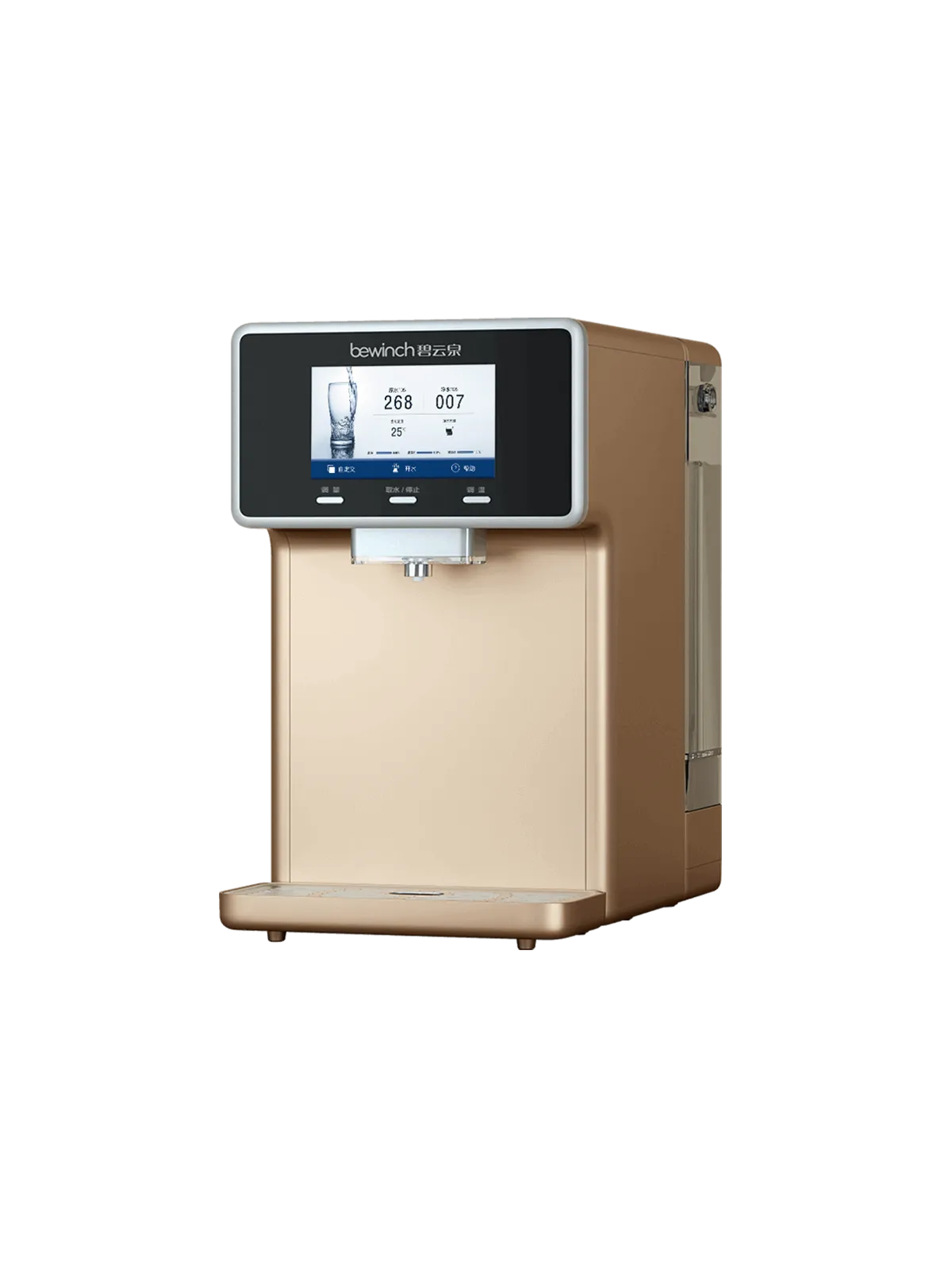
Bewinch K5 2-in-1 coffee machine & Alkaline Water Station – Capsule Machine + RO Purifier, 3s Hot Water for Espresso & Drinking | Compact Tabletop RK502
Description
No installation is required. Just plug it in and it can be used immediately.
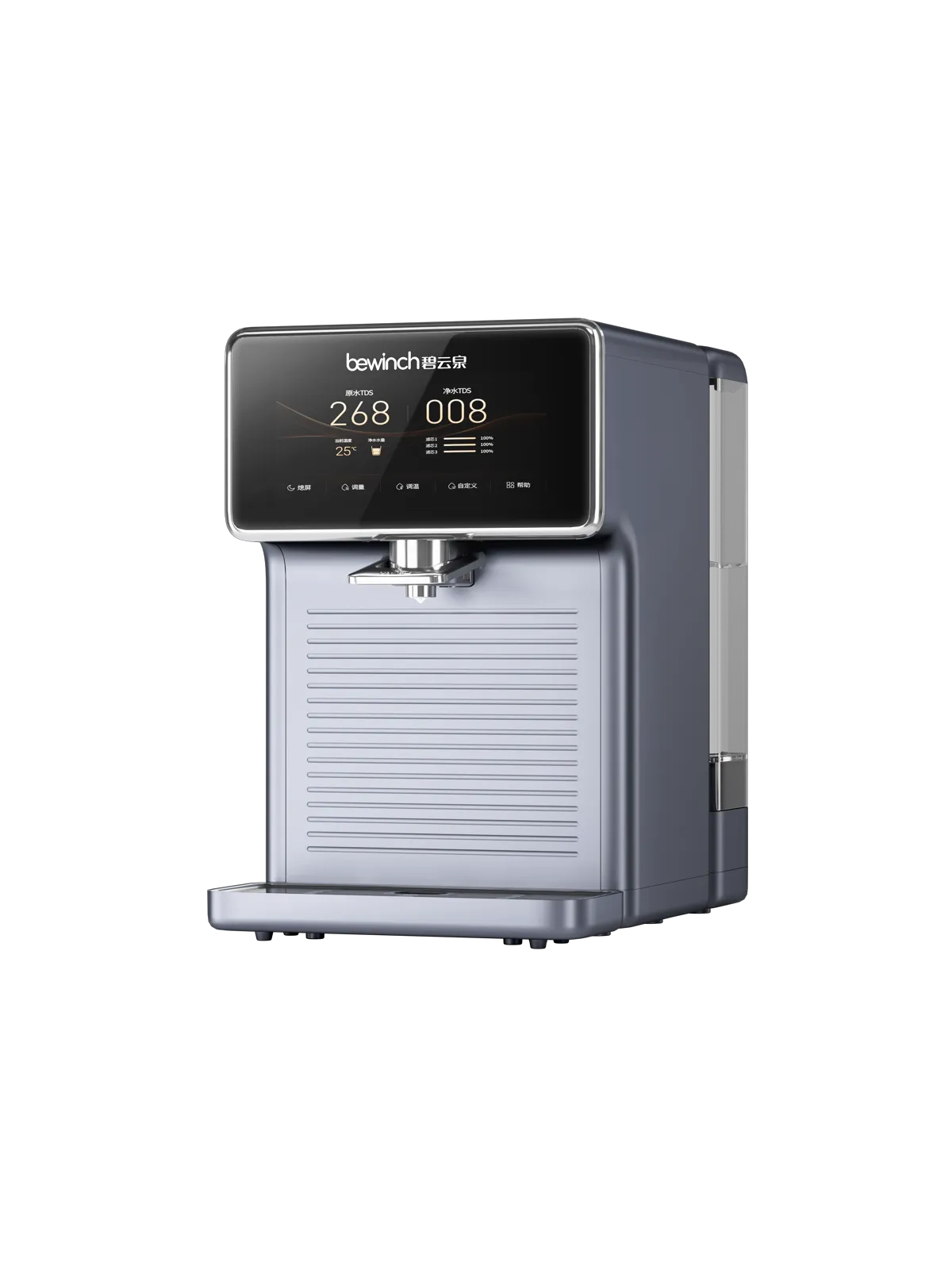
It has a high-end sense of technology and can be placed freely to match various styles.
Composite ultrafiltration for bacteria removal and fresh drinking.
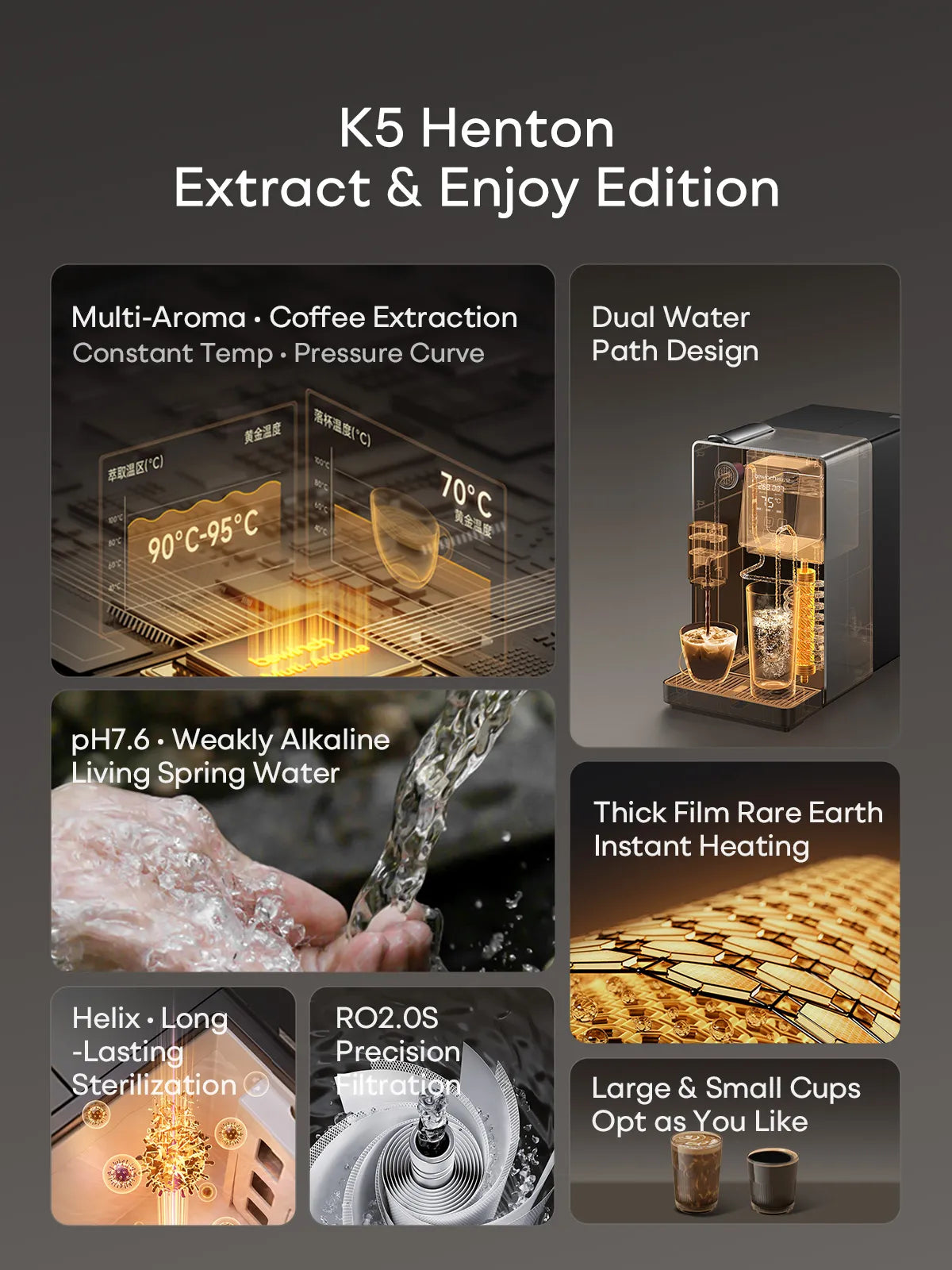
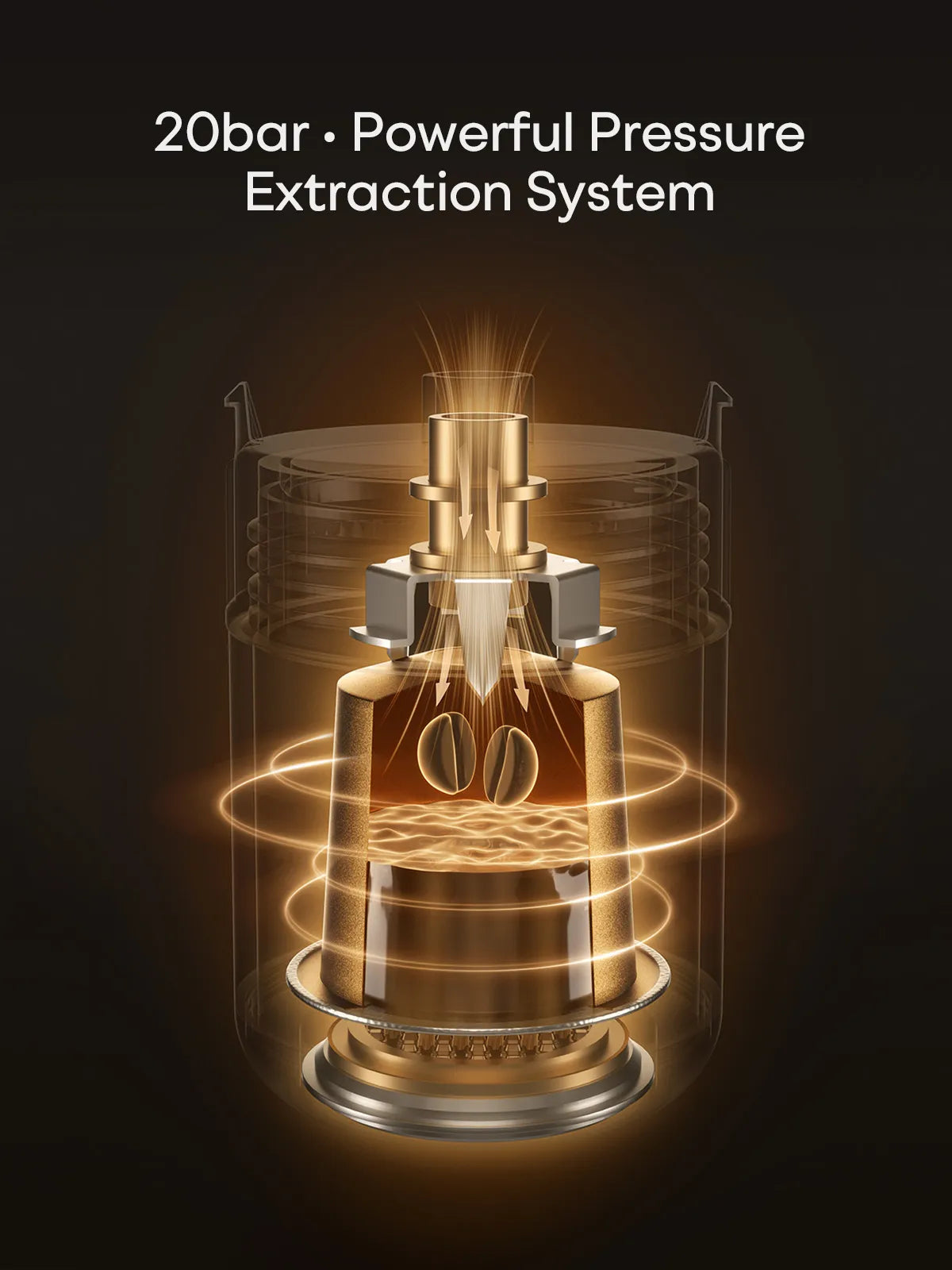
The strong pressure extraction ensures a rich and mellow taste.
Weakly alkaline live spring water with a pH value of 7.3
Decode the mellow aroma, presenting freshness and clarity.
The Muti-Aroma temperature control algorithm
ensures constant temperature control for a better flavor.
There is no need to boil it, and it can be directly drunk at room temperature.
With RO reverse osmosis technology, you can drink the good water with confidence.
It has seven temperature adjustment levels and can heat up in 3 seconds.
Say goodbye to the waiting time for boiling water. It is proficient in both direct drinking and brewing.
Four fixed - volume settings, stops automatically when the set water volume is reached
You can have full control over the water volume.
The coffee pipeline has a self-cleaning function.
With multiple safeguards, every cup is safe.
The Helix self-circulating ultraviolet lamp
automatically starts sterilization and provides long-term antibacterial effect.
It has its own water tank with a capacity of 5 liters
easily meeting the daily water needs of 4 to 5 people.
- Model:
- K5-Henton
Pairs well with
Free Shipping
We offer free door-to-door shipping,
Sit back, relax and wait for your delivery worry-free.Please refer to our shipping policy for more details.
14-Day Money-Back Guarantee
Get a full refund when you return your undamaged products within 14 days - for any reason. Once the item arrives back at the Bewinch warehouse for inspection, the refund process will begin.
See our refund policy for more details about what is needed for a smooth refund process.
1-Year Replacement-Only Warranty
Please contact us for a free brand-new machine replacement if any quality issues arise within 1 years.
2-Year RemoteTechnical Guidance
Covers a replace-only guarantee period with no cumulative calculation. Contact our official after-sales hotline 1-800-865-9960 for service support.
If you have any questions, you are always welcome to contact us. We'll get back to you as soon as possible, within 24 hours on weekdays.
-
Shipping Information
Use this text to answer questions in as much detail as possible for your customers.
-
Customer Support
Use this text to answer questions in as much detail as possible for your customers.
-
FAQ’s
Use this text to answer questions in as much detail as possible for your customers.
-
Contact Us
Use this text to answer questions in as much detail as possible for your customers.
You May Also Like



Join the membership
New machine usage guide
Filter cartridge purchase

Influencer recruitment


Specifications
Specifications
Brand
– Bewinch
Purification method
– Countertop
Product dimensions
– 22L x 36.5W x 36H centimetres
Material
– Acrylonitrile Butadiene Styrene
Capacity
– 5 Liters
Item weight
– 8.4 Kilograms
Included components
–User Manual
Purification method
– Reverse Osmosis
Maximum flow rate
– 0.9 Liters Per Minute
FAQs
Please read our FAQs page to find out more.
What is TDS?
- Total Dissolved Solids (TDS for short), also known as the total amount of dissolved solids, is measured in milligrams per liter (mg/L). It indicates how many milligrams of dissolved solids are contained in 1 liter of water.
- The higher the TDS value, the more dissolved substances there are in the water.
- Under normal circumstances, the higher the conductivity and salt content, the higher the TDS.
- In extreme cases, pure water is non-conductive, so its TDS is 0.
- According to national regulations, TDS is only one of the indicators reflecting water quality. For domestic water, the TDS must be ≤ 1000 mg/L.
Will there be any issues if the TDS of purified water stays consistently at 30?
- In the initial use stage, the embedded intelligent water quality monitoring module needs to be fully soaked by the water source. It’s normal for the TDS value to be higher or the monitoring frequency to be lower at this stage—you can use it with confidence.
- The WHO’s drinking water TDS standard is less than 50; the EU standard is less than 70; the US standard is less than 50.
- Biyunquan purified water has a stricter drinking water standard, ranging from 0 to 30. TDS values within 50 are safe for drinking.
- Suggestion: Rinse it several more times and observe for 5-7 days. If the TDS of the purified water still stays at 30, contact us and we will handle it promptly for you.
Why is there black powder in the water tank?
- When some users run water through a new device for the first time, black carbon powder may appear in the raw water tank. This is a normal situation, so you don’t need to worry.
- The activated carbon filter is made by sintering carbon powder with food-grade binders. It does not participate in human metabolism, so it is non-toxic and harmless to the human body. Its main function in the water purifier filter is to adsorb residual chlorine, pigments, odors, colloids, etc.
- When the new filter is rinsed with water for the first time after being opened, the activated carbon in the first-stage filter has not been fully activated by water, so some fine activated carbon powder will be discharged into the raw water tank. At this time, you only need to rinse the new device 3-5 times.
- If black carbon powder appears in the purified water tank, it is caused by the activated carbon in the third-stage filter. You can solve the problem by simply rinsing it with tap water, wiping it clean with a clean cloth, and then draining and rinsing it several times.
The water in the raw water tank becomes turbid during water production
- Cause of turbidity: The so-called "powder" is not actual powder, but dense bubbles formed by compressed air in the water. This is a normal physical phenomenon
- Technical principle of the device:It adopts reverse osmosis technology with a filtration precision of 0.1 nanometers;The diameter of water molecules is 0.4 nanometers, which cannot pass through the RO membrane under natural water pressure. A built-in booster pump is needed to pressurize the tap water, allowing water molecules to squeeze through the RO membrane, while all other impurities remain on the other side of the RO membrane;
- Logic of bubble formation: The water pump will highly compress the air in the water during operation, thus forming dense bubbles
- Conclusion: This phenomenon does not affect water quality, and the water is safe to drink
Why is there a layer of oil stain floating in the water?
- Phenomenon: When some users use a new device without rinsing it first, oil-like substances may appear on the water surface or at the water inlet and outlet valves after collecting water, and there will be an odd smell when drinking the water
- Cause: Food-grade grease is applied to the interface of the new filter. This grease is used to maintain the sealing state of the filter and facilitate filter replacement, and it is non-toxic and harmless to the human body
- Solution: The problem can be solved by rinsing the new device several times
Why is there "dirty stuff" (bubbles) in the hot water?
- Nature explanation: This is not dirty stuff, but air dissolved in the hot water
- Principle: The solubility of air in water increases as the temperature rises; when the hot water cools down after being left for a while, the solubility of air decreases, so the air separates from the water and forms bubbles
- Conclusion: This is a normal physical phenomenon that does not affect water quality, and the water is safe to drink
Is the TDS of purified water higher than that of raw water?
- Phenomenon explanation: When the TDS value of raw water is low (too pure), after treatment by the water purifier, the TDS of purified water may be higher (even exceeding the TDS of raw water)
- Cause: The raw water is too pure, so very little wastewater is produced after treatment by the No.2 RO reverse osmosis filter. This results in insufficient flushing of the purified water probe, which may lead to a slightly higher TDS of purified water
- Impact: This situation does not affect the normal operation of the device
- Verification suggestion: If you have doubts about this, you can use tap water with higher TDS for a week. You will observe that the TDS of raw water is higher than that of purified water, which proves that the device is fault-free and can be used normally
Why is the TDS I measured myself different from the one displayed on the screen?
- General causes of discrepancy:Water container: The cup used to hold water contains a small amount of impurities, and the air that the water comes into contact with during dispensing also carries some impurities, leading to deviations in the self-measured dataTesting tool: TDS test pens have instability in detection, and the data from different TDS test pens may not be the same; it is recommended to use professional and formal TDS detection devices
- National standard for drinking pure water: TDS≤50
- Causes of discrepancy for Biyunquan models with mineralization function:The pure water after mineralization contains various mineral ions, which will make the self-measured TDS value higherThe device’s purified water TDS detector is located between the second and third filters, and it detects the TDS of pure water that has not been mineralized, so there is a difference between this value and the self-measured (post-mineralization) value
Why does the device have a plastic smell?
- Causes:The main body of the water purifier contains many plastic parts. The new device is sealed from production, packaging to transportation, so some devices may have a plastic smellThe water-contacting plastic parts of the device are non-toxic and harmless, so it can be used safely
- Analogous explanation: Plastic products on the market (such as baby bottles, sports water cups) usually also have a certain plastic smell when first used
- Solution suggestion: Before using the new device, air it in a ventilated and cool place for 12-24 hours, then clean it according to the new device operation requirements, and then it can be used normally
What should I do if there is still a plastic smell after rinsing the new device?
- Forbidden operations:Due to the special material of the device, do not pour hot water into the raw water tankDo not use fresh lemons or other fruits to remove the smell of the new device: Fruits contain organic substances such as fructose. If they are not rinsed thoroughly, it is easy to cause bacterial growth, mildew, and odor
- Recommended deodorization solution:Material: Use the yellow packaged food-grade citric acid that comes with the device (its composition is similar to vitamin C, non-toxic and harmless)Operation steps:Dissolve the citric acid with warm water (ensure no crystal particles remain), then cool it to room temperatureIdentify the source of the odor (smell the raw water tank/purified water tank), pour the solution into the tank with a stronger odor, and perform drainage or water dispensing operations after soakingIf the dispensed water has an odor (may be the smell of silicone pipes for cold and hot water): Rinse the water dispensing pipes with the citric acid solution; the cold and hot water pipes are designed separately, so if the hot water has an odor, rinse the hot water pipes specifically
- Precautions:The water tank soaked with citric acid needs to be rinsed multiple times to ensure no citric acid residue, so as to avoid bacterial growth in the pipes
TDS increases after filter replacement
- Positioning of TDS: TDS cannot indicate the quality of water; it only serves as a reference standard for water quality
- Reasons for TDS increase after filter replacement:Food-grade grease is applied to the interface of the new filter (this grease is non-toxic and harmless to the human body, and its functions are to maintain the sealing state of the filter and facilitate filter replacement)The first use of the activated carbon filter will also lead to an increase in TDS value
- Suggestion: Rinse the device more than three times after replacing the filter
Why can’t the water be heated to 100°C?
- Reasons for temperature control:Device design: To avoid secondary pollution of purified water, the device adopts a closed structure; when water is heated to 100°C, it will boil and produce steam, causing excessive pressure inside the heating tube, which may burst the internal parts of the device.Energy consumption and efficiency: Although the heating tube is equipped with an automatic high-pressure discharge valve to avoid safety risks, the steam discharge followed by re-filling and heating will lead to slow heating, which is time-consuming and energy-intensive. Therefore, the heating temperature of water purifiers is usually controlled between 90°C and 100°C to ensure safe operation.
- Basis for water quality assurance:Limitation of conventional methods: Even if ordinary tap water is boiled to 100°C, it is difficult to eliminate harmful substances such as bacteria and heavy metals in the water.Filtration capability of the device: This device is equipped with a high-precision reverse osmosis RO membrane and 4-stage deep filtration technology, which can effectively filter out 99.99% of harmful substances such as sediment, rust, spores, cysts, bacteria, heavy metals, residual chlorine, and inorganic salts. The filtered water meets the national drinking water standard and can be drunk directly even without boiling.
Why does the outlet water temperature fluctuate repeatedly?
- Phenomenon explanation: When you do not adjust the temperature, the screen displays the real-time room temperature, which will change under the influence of the indoor temperature; since the temperature probe of the device is relatively sensitive, when the indoor temperature is at a critical value (e.g., between 27°C and 28°C), the temperature display may switch repeatedly between 27°C and 28°C
- Conclusion: This is a normal phenomenon and will not affect daily use
What should I do if the temperature is inaccurate?
- Normal causes of temperature deviation:The device detects the immediate temperature after the heating system. During the process of purified water flowing from the outlet to the cup, the water temperature will change with the ambient temperature (similarly, the water boiled in a kettle is not 100°C when poured into a cup)The device’s temperature control component will automatically adjust according to the ambient temperature, to prevent the outlet water temperature from being too high in summer or too low in winter
- Manual calibration steps for large temperature deviations:Continuously dispense 98°C water for 1-2 minutesContinuously dispense 85°C water for 1-2 minutesContinuously dispense hot water until switching to 45°C water, and keep dispensing for 1-2 minutesThe above operations can help the device adapt to the current ambient temperature
What should I do if the quantitative dispensing is inaccurate?
- Causes of quantitative dispensing errors:Water circuit design factor: Due to the machine’s water circuit structure design, the quantitative dispensing function may have a water volume error of ±10mL, which is caused by a small amount of residual water in the water circuit pipes. This is a normal phenomenonHot water heating factor: The error of quantitative hot water comes from the difference in heating temperature. The flow rate of water in the heating body will slow down and the water flow will become thinner, leading to deviations in quantification
- Suggestion: It is recommended to use a measuring cup or water bottle with precise scales for water dispensing measurement
Why is the flow rate of hot water lower than that of room temperature water?
- Cause (based on the specific heat capacity formula Q=cm△t):The higher the required temperature, the larger the temperature difference between the raw water and the target temperature, and the more energy is needed;The maximum power of the device is 2200W. To heat up quickly, the water flow rate is reduced to reach the specified temperature. The higher the temperature, the lower the corresponding flow rate. This phenomenon conforms to the physical law of conservation of energy and is a normal situation.
- Solution to improve hot water flow rate:You can purchase flagship models (such as N9/S7/S9) equipped with the patented RH servo instant heating technology;This technology integrates three instant heating technologies: dual-channel heating, intelligent pre-heating, and intelligent temperature sensing. Compared with traditional instant heating technology, it has higher heating efficiency, more precise and stable temperature control, and can provide a larger hot water flow rate in the same period.
Why does the device produce wastewater?
- Nature and function of the "wastewater":It is not "wastewater" but concentrated water generated during filtration. It is the water used to flush impurities from the RO membrane in RO reverse osmosis models, aiming to maintain the normal use and service life of the filter.
- Explanation of the purified water to wastewater ratio:The device’s 3:1 purified water to wastewater ratio is a relatively low ratio on the premise of protecting the RO membrane’s service life; a lower wastewater ratio is not necessarily better. Products with lower filtration precision (such as the M3 bacteria-filtering water dispenser using ultrafiltration technology) do not produce wastewater.
- Value of high-precision filtration and secondary use of the concentrated water:High-precision filtration models can provide better drinking water protection, and the cost of the concentrated water is low (at a water price of 2.3 yuan/ton, drinking 2-3 cases of water per day, the annual cost of the concentrated water will not exceed 10 yuan).The concentrated water is cleaner than ordinary tap water (not drinkable), and can be collected for secondary use such as mopping floors and watering plants.
Will the wastewater stored in the raw water tank and mixed with raw water affect the water quality?
- Tank structure and stratification mechanism:Raw water and wastewater share one tank; the raw water inlet is located in the upper layer of the tank, and the wastewater outlet is in the lower layer;Since wastewater has a higher density, it will form a natural stratification with raw water. Combined with the filter flushing technology inside the device, there will be no repeated filtration of wastewater.
- Water quality guarantee measures:The device has a built-in purified water tank. The pure water after four-stage filtration is pre-stored in the purified water tank, ensuring the drinking water is safe and pollution-free.
- Concentration reminder and water change operation:When the concentration of water in the raw water tank reaches the threshold, the device will send a raw water replacement reminder;When changing water, you only need to pour out the wastewater and add fresh raw water, which will not affect the water quality.
How to replace the raw water?
- Reference for purified water to wastewater ratio:Biyunquan models adopt reverse osmosis technology, with a purified water to wastewater ratio of about 3:1;Taking a 4L water tank as an example, when full, it can produce about 3L of pure water and 1L of wastewater (the actual situation will vary according to local water quality).
- Replacement timing: When the red water cup icon appears on the screen to remind you to replace the raw water.
- Replacement operation: Pour out the remaining water in the raw water tank and add new water.
- Precautions:You don’t need to turn off the power every time you change water; just make sure to pull out the water tank when the booster pump is not working;Do not pull out the water tank when the device is producing water, otherwise it may cause the device to suck in air and malfunction.
Does the filter have a shelf life?
- Shelf life of the filter: The shelf life of the filter is five years.
- Storage requirements: Do not open the filter's packaging bag, and store it in a cool place. There is no need to worry about the expiration issue when stocking up.
What happens if I don’t replace the filter?
- Impacts of not replacing the filter:Alarm reminder: During each water dispensing process, the device will continuously emit a beep alarm, and the filter life indicator light will flash (to remind you to replace the filter);Equipment failure: The filter may become clogged, making it impossible to produce water normally; maintaining this state for a long time will damage the booster pump;Function and water quality issues: The activated carbon filter will fail, unable to achieve adsorption and taste improvement effects, and may even breed microorganisms.
- Recommendation: Replace the filter in a timely manner.
How to replace the filter?
- Replacement reminder:The device will continuously emit a beep alarm during each water dispensing process, and the filter life indicator light will flash to remind you to replace the filter;Biyunquan recommendation: Be sure to replace the filter in a timely manner.
- Replacement steps:Open the device: Press and slide the top cover of the device forward to open it;Remove the old filter: Hold the handle above the filter, rotate the pointer from "Lock" to "Unlock" position, and gently lift the filter to complete the removal of the old filter;Install the new filter: Align the pointer of the new filter with the "Unlock" mark and insert it into the corresponding slot; Hold the handle above the filter, rotate the pointer from "Unlock" to "Lock" position (confirm that the filter cannot be lifted), and complete the installation of the new filter.
- Precautions: After replacing the filter, a reset operation is required. Please refer to the filter replacement reset guide for the corresponding model for specific operations.
What should I do if the filter is accidentally reset?
- Handling of accidental reset of Filter 2:The service life of Filter 2 is 18-24 months;Two remaining bars before reset: corresponding to about 60% of the service life (around 1 year);One remaining bar before reset: corresponding to more than half a year of service life;Judgment of exhausted service life: The TDS value of purified water keeps rising and draining has no improvement. At this time, the filter needs to be replaced, and it is recommended to prepare and purchase it in advance;Reminder method: You can pay attention to the TDS value of purified water through the TDS intelligent display.
- Handling of accidental reset of Filter 1/3:If only 1 bar is left before reset, the remaining service life is less than 2 months;It is recommended to purchase the filter in advance;Reminder method: You can pay attention to the TDS value of purified water through the TDS intelligent display.
What factors are related to the filter's service life?
- Dimensions related to the filter's service life (3 in total):Power-on time: Used as the basis for calculating the shelf life. Similar to bread going bad when left standing after opening, the filter may breed microorganisms (moldy, smelly, or excessive microorganisms) even if it is not used for a long time after being exposed to water. Therefore, the power-on time follows the timing logic of food shelf life.Water quality TDS change: The smart chip dynamically calculates the service life based on the TDS value of the raw water. The dirtier the raw water, the shorter the filter's service life.Water intake flux: Refers to the total amount of water taken from the water purifier. The more water taken and the more frequently it is used, the shorter the filter's service life.
- Supplementary note:The filter service life indicator is a recommended replacement cycle, not mandatory. However, it is not recommended to replace the filter only after it is completely scrapped; if the filter is completely blocked, it may cause safety hazards such as booster pump overload and pipe rupture.
Why is there a hissing sound after water production?
- Nature of the sound: It is not a hissing sound, but a normal sound of filter flushing.
- Related procedure: The device will run a vortex convection flushing procedure of about 15 seconds after water production (this procedure is set to improve the filter's service life).
- Function of the procedure: It can flush away ionic impurities on the surface of the filter membrane, thus ensuring the filter's service life and drinking water health.
- Execution frequency: This procedure will be automatically executed after each water production.
How to solve the problem that the device does not produce water (air trapped)?
- Cause of no water production: It is most likely an air trapped issue, which is easily caused by plugging or unplugging the filter during water production.
- Steps to remove trapped air:Step 1: Disconnect the power supply, open the top cover of the device, and pull out the filter;Step 2: Use tools like chopsticks to poke the hole at the bottom of the filter to loosen and release air (Note: If there is resistance when pressing the chopstick, it means air is trapped. At this time, gas and water may splash from the bottom of the filter. Do not point the bottom of the filter upward at a person's face during operation);Step 3: Repeat Step 2 for the remaining filters. After exhausting air, tighten the filters, wipe the tabletop dry, and close the top cover of the device to use it normally.
- Follow-up suggestion: If the device still does not produce water after performing the above operations, please contact the official store customer service.
Is the water dripping from the outlet normal, and how to handle it?
- Judgment and handling for different scenarios:Dripping after taking water: If the dripping stops within 1 minute, it is a normal situation;Dripping when not taking water: Observe whether the water dripping in 8 hours can fill the water collection box below. If the box is filled, maintenance is required (replace the check valve or air-water separation box).
What causes the machine to leak water at the bottom, and how to handle it?
- Possible causes of water leakage and handling methods:Cause 1: Water spilled during use, or the water volume in the raw water tank exceeds the maximum water level lineHandling: First perform a self-check to confirm whether the above situations exist;Cause 2: Loose filterHandling: Open the top cover of the machine and check whether the filter is installed in place; Remove the 3 filters one by one, re-align and tighten them back; After closing the top cover, wipe dry the water stains on the desktop and the bottom of the machine before taking water.
Why isn’t the sterilization light turning on?
- Working mode of the sterilization light (UV light): It adopts an intelligent detection sterilization design and does not stay on continuously.
- Method to verify the normal operation of the UV light:Premise: The purified water tank is full;Operation: Turn off the power, wait 30 seconds, then turn the power back on;Judgment: If the UV light turns on at this time, it means it is working normally.
What should I do if there is limescale in the raw water tank?
- Descaling tool: Citric acid (featuring health, environmental protection, efficient descaling and no residue).
- Descaling steps:Step 1: Take a cup of hot water above 65°C, and pour 5-10 grams of citric acid (adjust the dosage according to the severity of limescale);Step 2: Wait for the citric acid to dissolve completely and the hot water to cool down;Step 3: Fill the raw water tank with tap water, and pour the dissolved citric acid water into it;Step 4: After waiting for about 10 minutes, wipe the inner wall of the raw water tank with a clean cotton cloth;Step 5: Pour out all the citric acid water, and rinse off the residual citric acid water with tap water.
Why does the machine make noise?
- Causes and explanation of the noise:Technical basis: To ensure water safety, the machine uses an RO reverse osmosis membrane; reverse osmosis technology requires squeezing water molecules into a reverse osmosis membrane with a pore size 4 times smaller than the molecule. This cannot be achieved with normal water pressure alone, so a booster pump is needed to assist the water source in passing through the RO membrane (without the booster pump, harmful substances cannot be effectively removed);Nature of the noise: The booster pump will produce a certain sound when operating, which is a normal phenomenon;Working period: The booster pump only works when the water tank is producing water. It does not make noise at other times and will not affect daily life.